





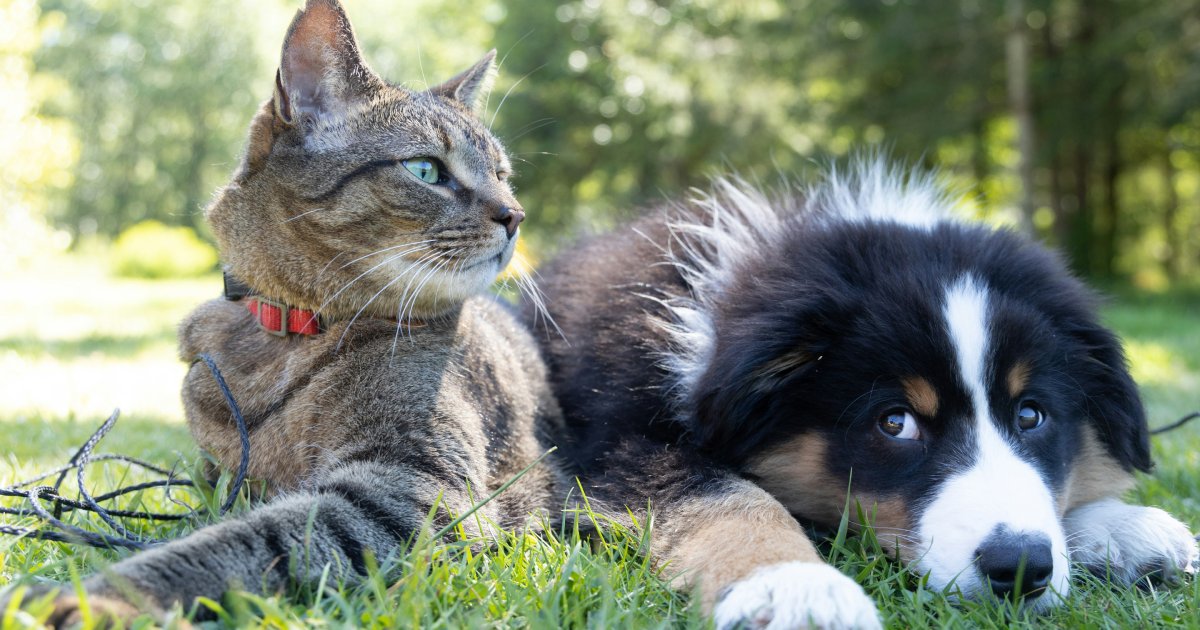

For households with both dogs and cats, choosing the right probiotic raises genuine questions. Here is what the science says about sharing, specificity, and safe cross-species use.
Living with both dogs and cats is a rewarding experience, yet it introduces practical questions when it comes to nutrition and supplementation. One of the most common concerns among multi-pet owners is whether a single probiotic product can serve both species. Can a universal formula deliver equivalent benefits? Would a species-specific product outperform it? And if a dog-formulated supplement is all that is available, can it be given to a cat safely?
These are not trivial questions. The answer lies in the distinct gastrointestinal ecology of dogs and cats — differences shaped by millions of years of divergent evolution, dietary adaptation, and metabolic specialization. Understanding these biological distinctions is the first step toward making an informed, evidence-based choice.
The Biological Starting Point: Two Different Gut Ecosystems
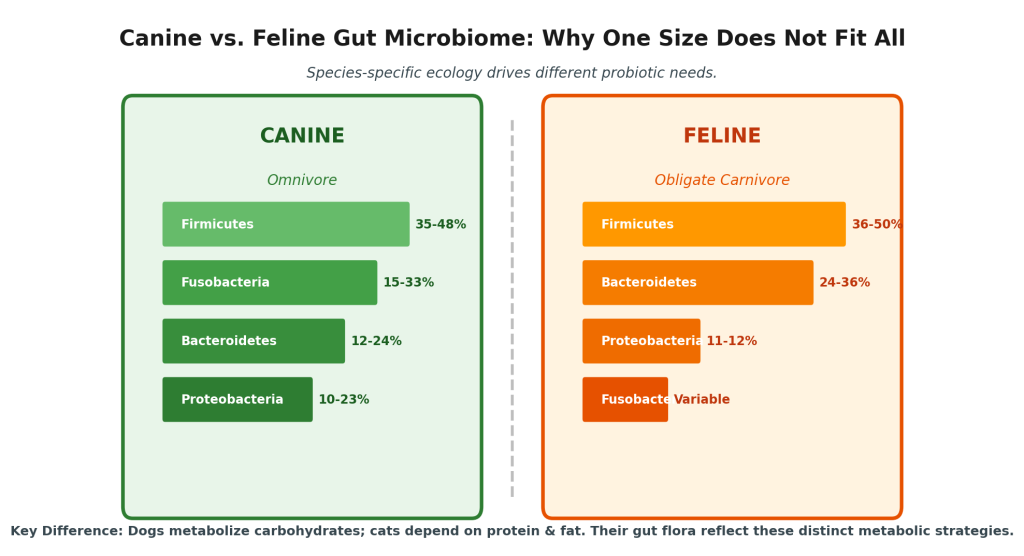
Although dogs and cats share a carnivorous ancestry, their digestive physiologies diverge in important ways. Domestic dogs are metabolic omnivores, capable of digesting and utilizing a broad range of carbohydrates, proteins, and fats. Domestic cats, by contrast, are obligate carnivores, evolutionarily adapted to high-protein, high-fat diets with minimal carbohydrate metabolism. These dietary differences are reflected directly in their gut microbiomes.
Molecular profiling via 16S rRNA sequencing reveals that both species harbor Firmicutes, Bacteroidetes, Proteobacteria, and Fusobacteria as dominant phyla. However, the proportions differ markedly. In healthy dogs, Fusobacteria often represent the most abundant phylum in the colon and ileum, while feline guts are dominated by Firmicutes, with higher relative abundances of Bacteroidetes and Prevotella. These compositional differences are not merely taxonomic curiosities; they reflect fundamentally different microbial fermentation strategies, nutrient-processing capacities, and immune-modulatory environments.
Question 1: Can Dogs and Cats Share a Universal Probiotic?
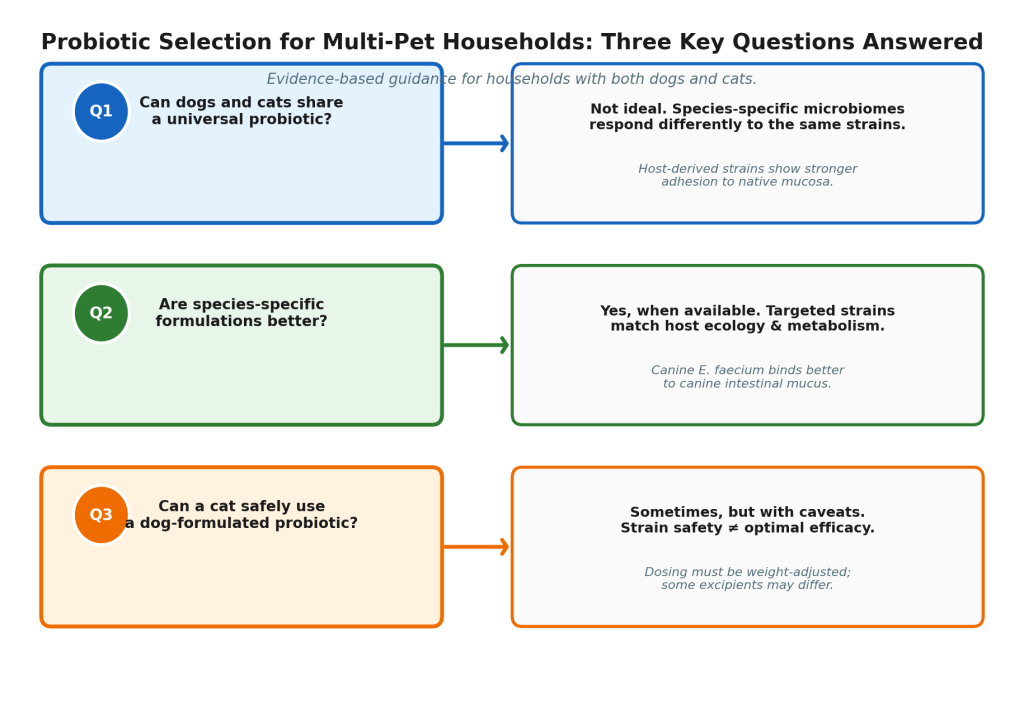
The honest answer is that it is not ideal. While some probiotic strains — most notably Enterococcus faecium SF68 — have demonstrated safety and efficacy in both species, the broader principle of host specificity suggests that benefits are not automatically transferable. Research published in Frontiers in Veterinary Science demonstrates that canine-derived probiotic strains exhibit significantly greater adhesion to canine intestinal mucosa than to feline or porcine mucosa, and vice versa. Surface hydrophobicity assays confirm that host-origin strains possess the strongest binding affinity for their native host’s mucosal surfaces.
This matters because adhesion is a prerequisite for colonization, immune signaling, and competitive exclusion of pathogens. A strain that thrives in a dog’s fusobacteria-rich environment may not establish effectively in a cat’s firmicutes-dominant gut. Therefore, while cross-species use is not inherently dangerous, it may be suboptimal from an efficacy standpoint.
Question 2: Are Species-Specific Formulations Superior?
When available, yes. Species-specific formulations are designed with the host’s unique microbiome, metabolism, and body size in mind. They typically feature strains isolated from the target species, dosed appropriately for the animal’s weight and gastrointestinal volume, and formulated without excipients that may be problematic for one species but not the other.
For example, Enterococcus faecium SF68 — one of the most extensively studied companion-animal probiotic strains — has been shown to stimulate immune function in young dogs, as evidenced by increased fecal IgA and vaccine-specific circulating IgG and IgA. In cats, the same strain has demonstrated efficacy in reducing diarrhea episodes in shelter environments and in maintaining fecal microbiome diversity during antibiotic therapy. These parallel but distinct findings underscore that a single strain can benefit both species, yet the optimal delivery format, dose, and supporting formulation may differ.
Question 3: Can a Cat Safely Use a Dog-Formulated Probiotic?
In many cases, yes — with important caveats. Safety and efficacy are not identical concepts. A probiotic strain that is safe for dogs is generally safe for cats if the strain itself has been evaluated in feline populations. However, several practical factors must be considered:
First, dosing must be weight-adjusted. A daily dose calibrated for a 25-kg dog will likely exceed what a 4-kg cat requires, potentially causing transient gastrointestinal upset. Second, excipient matrices — the carriers, flavorings, and binders used in chewable tablets or powders — may differ between canine and feline products. Some canine formulations contain ingredients, such as certain plant fibers or flavor enhancers, that are less suitable for feline digestion or palatability. Third, the strain portfolio in a dog-specific product may emphasize species that colonize canine mucosa more effectively, offering diminished returns for a cat.
The best practice is to select a product explicitly labeled for the target species, or at minimum, a product containing strains with documented feline safety and efficacy data. If cross-use is unavoidable, consult a veterinarian for dose conversion and monitor for any adverse signs.
The Bottom Line
The gut microbiome is not a generic environment. It is a species-specific ecosystem shaped by diet, anatomy, and evolutionary history. While certain well-characterized probiotic strains — particularly those with broad companion-animal evidence bases — can bridge the canine-feline divide, the most reliable approach is to match the product to the species. For multi-pet households, this may mean keeping two separate supplements on hand. The modest inconvenience is outweighed by the confidence that each animal is receiving support tailored to its unique biology.
References
1. Barry KA, Middelbos IS, Vester Boler BM, et al. (2012). Effects of dietary fiber on the feline gastrointestinal metagenome. Journal of Proteome Research, 11(12), 5924–5935.
2. Suchodolski JS, Camacho J, Steiner JM. (2008). Analysis of bacterial diversity in the canine duodenum, jejunum, ileum, and colon by comparative 16S rRNA gene analysis. FEMS Microbiology Ecology, 66(3), 567–578.
3. Frontiers in Veterinary Science. (2026). Host-specific probiotics in canine and feline functional foods: Host specificity and probiotic strain types. Frontiers in Veterinary Science, 13, 1881134.
4. Benyacoub J, Czarnecki-Maulden GL, Cavadini C, et al. (2003). Supplementation of food with Enterococcus faecium (SF68) stimulates immune functions in young dogs. The Journal of Nutrition, 133(4), 1158–1162.
5. Bybee SN, Scorza AV, Lappin MR. (2011). Effect of the probiotic Enterococcus faecium SF68 on presence of diarrhea in cats and dogs housed in an animal shelter. Journal of Veterinary Internal Medicine, 25(4), 856–860.
6. Torres-Henderson C, Summers S, Suchodolski J. (2017). Effect of Enterococcus faecium strain SF68 on gastrointestinal signs and fecal microbiome in cats administered amoxicillin-clavulanate. Topics in Companion Animal Medicine, 32(3), 104–108.