



You are staring at the probiotic shelf, and every bottle claims to fix everything. One has eight strains. Another has fifteen billion CFU. A third promises ‘total digestive wellness.’ You know your dog has a specific problem—diarrhea, constipation, itchy skin, or post-surgery recovery—but the labels do not tell you which strains actually address which issue. Here is how to decode them.
Symptom-to-Strain Quick Reference
Most effective canine products contain multiple strains that work through different mechanisms. The table below shows which combinations have the strongest evidence for each condition.
| Symptom / Condition | Recommended Strain Combination |
| Acute diarrhea / Antibiotic recovery | Enterococcus faecium SF68 Bifidobacterium animalis AHC7 Saccharomyces boulardii |
| Stress-induced soft stool (Travel, boarding, moving) | Enterococcus faecium SF68 Lactobacillus rhamnosus |
| Constipation / Sluggish motility | Lactobacillus plantarum Sodium butyrate + Prebiotic fiber (FOS or pumpkin) |
| Food allergy / Atopic dermatitis (adjunct) | Lactobacillus rhamnosus Lactobacillus plantarum Sodium butyrate |
| Post-surgical gut recovery | Bacillus subtilis C-3102 Saccharomyces boulardii Sodium butyrate |
| Chronic low-grade inflammation / IBD support | Bacillus subtilis C-3102 Lactobacillus plantarum Sodium butyrate |
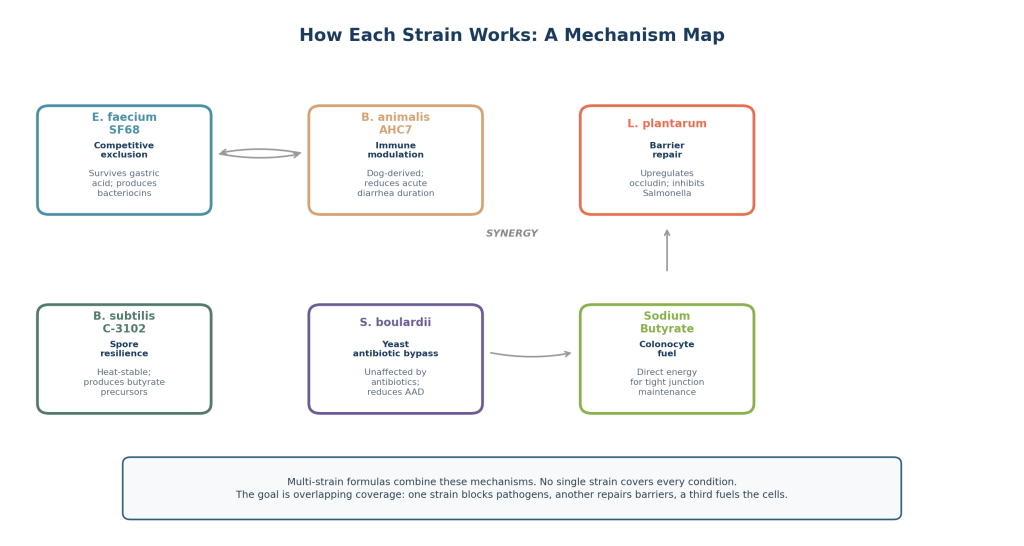
No single strain covers every condition. The most effective formulas combine overlapping mechanisms: one blocks pathogens, another repairs the gut wall, and a third fuels the cells that line the intestine.
Strain Profiles: What Each One Does
The following strains appear most frequently in evidence-backed canine products. Each has a distinct mechanism, and each can contribute to multiple conditions when combined with complementary strains.
Enterococcus faecium SF68
A canine-validated bacterium with clinical evidence for reducing acute diarrhea duration. It survives gastric acid, adheres to intestinal mucosa, and produces bacteriocins that compete with pathogenic species. In controlled trials, dogs receiving SF68 showed reduced diarrhea severity compared to placebo (Kelley et al., 2009).
Best contributes to: Acute diarrhea, antibiotic-associated diarrhea, stress-induced soft stool, post-surgical recovery.
Bifidobacterium animalis AHC7
A dog-derived strain shown to reduce the severity and duration of acute idiopathic diarrhea. Its effects are strain-specific; other B. animalis subspecies have not demonstrated equivalent results. AHC7 appears to work primarily through immune modulation rather than direct pathogen inhibition.
Best contributes to: Acute diarrhea, immune-mediated gut inflammation, recovery from dietary indiscretion.
Lactobacillus plantarum
Demonstrated in vitro to inhibit Salmonella adhesion to canine intestinal cells and to upregulate occludin, a tight junction protein. Its primary value lies in barrier support and pathogen exclusion. It also supports short-chain fatty acid production, which fuels colonocyte contractions.
Best contributes to: Food allergy adjunctive support, constipation, chronic low-grade inflammation, barrier repair after dysbiosis.
Bacillus subtilis C-3102
A spore-forming bacterium with exceptional environmental stability. The spore form allows it to survive storage, gastric acid, and antibiotic exposure intact. Clinical studies in dogs have shown improved fecal quality, reduced ammonia production, and a trend toward increased fecal butyrate (Isidori et al., 2021).
Best contributes to: Post-antibiotic recovery, post-surgical gut restoration, chronic inflammation, long-term maintenance in dogs with recurrent GI sensitivity.
Saccharomyces boulardii
A probiotic yeast, not a bacterium. It is unaffected by antibiotics and has been shown to reduce antibiotic-associated diarrhea in multiple species. Because it is a yeast, it can be given concurrently with bacterial antibiotics without being destroyed. Caution is warranted in immunocompromised dogs due to rare reports of fungal bloodstream infection.
Best contributes to: Antibiotic-associated diarrhea prevention, post-surgical recovery during antibiotic therapy, acute diarrhea when bacterial probiotics are contraindicated.
Lactobacillus rhamnosus
Has been shown to interact with dendritic cells in the gut wall, promoting regulatory T-cell differentiation and anti-inflammatory cytokine production (IL-10, TGF-beta). This immunomodulatory profile may help dampen the exaggerated immune response associated with food sensitivity and atopic dermatitis.
Best contributes to: Food allergy adjunctive support, stress-induced GI upset, immune modulation in dogs with chronic skin and gut inflammation.
Sodium butyrate
Not a live organism, but the primary energy source for colonocytes. Direct supplementation bypasses microbial fermentation and provides immediate fuel for tight junction maintenance and mucin production. It is frequently included in synbiotic formulations to amplify the barrier-repair effects of live probiotics.
Best contributes to: Constipation, chronic inflammation, food allergy support, post-surgical barrier repair, any condition where colonocyte energy supply may be compromised.
What to Avoid
Not every product on the shelf is appropriate. The following categories should be excluded from canine use:
- Human-only strains (e.g., L. rhamnosus GG, B. lactis BB-12): optimized for human gastric pH; survival in canine stomach drops below 5 percent.
- Products containing xylitol: highly toxic to dogs; triggers insulin release and hypoglycemia at low doses.
- High-lactose formulations: dogs have reduced lactase activity post-weaning; excess lactose causes osmotic diarrhea.
- Unidentified proprietary blends: strain-level identity determines efficacy; products without specific strain designations are unverifiable.
- Live bacterial probiotics in severely immunocompromised dogs: use only under veterinary supervision; postbiotic alternatives are safer.
When evaluating a multi-strain product, count mechanisms, not strains. A formula with three well-characterized strains covering competitive exclusion, barrier repair, and immune modulation is more valuable than a formula with ten unidentified strains.
Frequently Asked Questions
Q: Can I combine multiple strains myself?
Multi-strain formulations are common and generally safe. However, the evidence supports specific combinations with complementary mechanisms, not random mixing. Choose products with clinically validated pairings rather than the highest strain count.
Q: How long before I see results?
Acute diarrhea: 48 to 72 hours. Constipation: 3 to 5 days if fiber and hydration are also addressed. Skin allergy support: 8 to 12 weeks. Post-surgical recovery: 7 to 14 days.
Q: What if a product has strains not listed here?
New strains enter the market regularly. Look for canine-specific validation, strain-level identification, and published clinical data. If the manufacturer cannot provide these, the strain’s value is unverified.
The Bottom Line
Effective canine probiotics are not about the highest CFU count or the longest strain list. They are about matching mechanisms to symptoms. A multi-strain formula that combines competitive exclusion (E. faecium SF68), barrier repair (L. plantarum), and colonocyte fuel (butyrate) can address diarrhea, constipation, and allergy support more comprehensively than any single strain alone. Read the label for strain IDs, avoid human-only products and xylitol, and remember that probiotics are adjuncts—not replacements—for veterinary diagnosis.
References
Kelley, R. L., Minikhiem, D., Kiely, B., et al. (2009). Clinical benefits of probiotic canine-derived Bifidobacterium animalis strain AHC7 in dogs with acute idiopathic diarrhea. Veterinary Therapeutics, 10(3), 121–130.
Jergens, A. E., Guard, B. C., Morrison, J. A., et al. (2019). Fecal short-chain fatty acid concentrations and dysbiosis in dogs with chronic enteropathy. Journal of Veterinary Internal Medicine, 33(4), 1608–1616. https://doi.org/10.1111/jvim.15509
Isidori, M., et al. (2021). Effect of probiotic supplementation on clinical and metabolic parameters in dogs with chronic inflammatory enteropathy. PubMed 34944195.
PMC7877677. Perioperative probiotic treatment in dogs undergoing hemilaminectomy: effects on fecal dysbiosis index and clinical outcomes.
Disclaimer: This article is for educational purposes only and does not replace professional veterinary advice.